
Some things begin not with a plan but with a longing.
Michael and Hanna knew exactly what kind of life they wanted.
Not the life the world said they should want: the optimized one, the connected one, the one that moves fast and measures everything and never quite stops.
The life they actually believed in.
The one built on the things that have nourished human beings for as long as human beings have existed: a meal made slowly with someone you love, a garden tended by hand, a morning that starts with sunlight instead of a screen, an evening that belongs to a book and a blanket and the sound of rain and the person beside you.
They believed in these things the way you believe in gravity — not because someone told them to, but because the evidence was everywhere and had been for millennia.
And yet the world was constantly pushing them toward something else. Faster. Louder. More optimized. More connected to screens and less connected to each other. More influenced by strangers who knew nothing about their lives but had plenty of opinions about how to live them.
And then the distance between the life they believed in and the life they were living became impossible to ignore. Michael was carrying the grinding weight of burnout —the kind that doesn't announce itself but sits on your chest a little heavier every morning until you can't remember what it felt like to breathe without it.
Something essential in them was being crushed. Not dramatically. Slowly. The way noise crushes silence — not by breaking it but by filling every space where it used to live.
So Michael made a picture.
Not a business plan. Not a strategy. A picture.
A small orange kitten in a warm kitchen with golden light through the window and flour on the counter and a loaf of bread that somebody made from scratch because making things from scratch is how you tell the world you're not in a hurry.
He made it for Hanna, because she had always carried a vision of a life built on the things that don't change — work that means something, a home tended with your own hands, traditions honored because they earned it, a pace that lets you feel the days instead of just surviving them — and he understood, in the way that the people who love us best always understand, that what she needed wasn't an escape from the hard season. It was a vision of the life on the other side of it.
He didn't just create a cute character. He created the life they wanted. He put it into a picture. He gave it fur and paws and a warm kitchen and a garden and a country town of open fields and split rail fences and bee balm, the kind of American country town where the fields roll out to meet the hills and the sky goes on forever.
And when Hanna saw it, she didn't just feel comforted. She felt seen. Because the character was living the life she'd been longing for: the one rooted in the principles that have always been true, the one built on work and craft and the self-evident knowledge that a life doesn't need to be fast to be full. The one the world kept telling her was naïve or impractical or not enough. And there it was, on a screen, made real by the person who understood her best. A warm kitchen. A loaf of bread. A life that didn't need anyone's permission to be good.
And it was enough. It was always enough.
A second character appeared soon after — because the life they believed in was never solitary. It was shared. A small gray companion arrived beside the first as naturally as a best friend appears beside you when the table is set for two. Two friends baking bread together. Two friends walking in the rain together. Two friends on a porch swing with lemonade and nowhere to be, because the whole point of the afternoon was the person beside you and the glass in your hand and the fields turning gold in the distance.
They named them Casey Bennett and Kenzie Ryder.
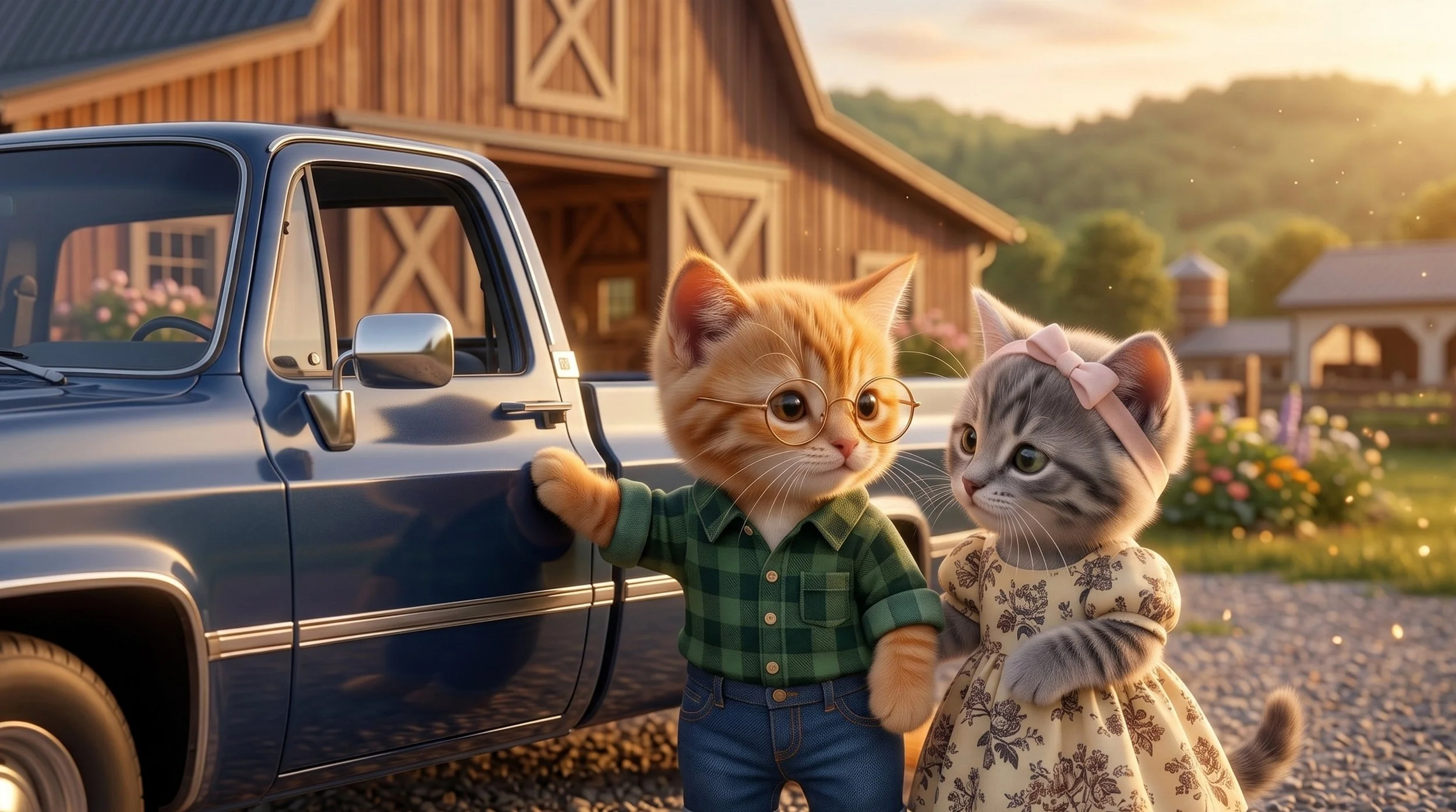
Casey is the one with the round gold wire-frame glasses who stands on crates to reach things and smells bread with his eyes closed and mows the lawn in straight lines and has never once let his height stop him from reaching for the highest apple on the branch.
Kenzie is the one with the ribbon in her hair who folds laundry by color and selects the reddest strawberry in the patch and writes the labels on the herb jars and chose her pony because the pony looked at her the way gentle things look at gentle things when they recognize each other.
They live in a country town called Kettlestone, where the fields, the woods, and the hills all meet in one place. There's a café called The Cozy Cup where the chalkboard menu hasn't changed in years because it was right the first time. Penny Bun Bakery with a window full of bread. Bennett & Baker Books, with shelves that reach the ceiling. A greenhouse where everything that blooms in the garden begins. Orchards and strawberry fields that stretch to the hills. A red barn and a pasture where the horses graze. A creek you can paddle if you know where to put the canoe in. A hill you can climb if you start early enough, where the whole valley opens up gold beneath you. A treehouse with a door painted the color of the sky.
There's a small secret in the name, if you go looking for it. The kettle is the one that's always on, the one that says the door is open and there's time to sit a while. And the key is the one that was never really needed, because a home like this is never locked to the people it loves. Kettle and Key was never two pretty words chosen to sound cozy. It's a kettle on the stove and a key in an open door. It's the shape of a welcome. It's a real place, or it feels like one, which in a storybook is the same thing.
Casey and Kenzie bake bread and tend gardens and pick blueberries and catch fireflies and build things with their hands and read books by lamplight and walk the pony home in the last of the gold light and sit on a porch swing with lemonade because they built a life that has room for all of it.
They do what has always worked. What has always nourished. What has been self-evidently true about how to live a good life for as long as anyone has been alive. They are not characters who retreated from the world. They are characters who chose a better way of living within it. They are leaders in their own lives, not followers of anyone else’s prescription. And the life they lead is sufficient. The bread is warm. The garden is growing. The person beside them is their favorite person. That is enough. That has always been enough.
When Michael and Hanna started sharing the images, the response surprised them. People didn’t just like them. They felt seen by them. Messages arrived from people in their own difficult seasons: people who said the images made their evening warmer, reminded them of mornings with their best friend, made them want to put their phone down and bake something or walk somewhere green or sit with their person and do nothing together for the first time in months.
The longing Michael and Hanna had felt wasn't just theirs. It was everywhere. And the world they'd built wasn't just for them. It was for anyone who had ever looked at the pace of modern life and thought: there has to be a better way. And known, in their bones, that the better way wasn't new. It was ancient. It was simple. It was bread and gardens and books and the person beside you and the courage to say that's enough.
The Ones Who Made This World
Kettle & Key is created by Michael and Hanna. They built this world out of the country they love, the rural America of open fields and back roads and small towns, drawn with the warmth of people who believe this way of living is worth honoring.
Michael is the artist. He builds every scene with care and intention — the lighting, the composition, the atmosphere, the copper pots on the shelf and the condensation on the greenhouse glass and the paw prints in the orchard soil. His standard is uncompromising: nothing goes out that doesn’t make you want to climb inside it.
Hanna is the writer and the strategist. She shapes the brand’s voice, its stories, its collections, and the experience of everything the audience sees and feels. The captions that make you hold your breath. The world-building that makes the village feel real. The unwavering conviction beneath it all that this matters — that this world, and the life it represents, is worth fighting for.
Together, they make every decision by asking one question: does this belong in the world? If the answer isn’t yes, it doesn’t exist.
What We Believe
The things that truly nurture us have never changed. A morning in nature. A meal shared without hurry. A story read aloud. A hobby pursued for its own sake. A home kept with care. A friendship tended like a garden. These things were true before the internet. They’ll be true long after. They were enough for our grandparents and their grandparents and they are enough for us.
We believe that slowing down is not falling behind. That leading your own life is braver than following someone else’s. That the people who quietly do what has always worked — who bake the bread, tend the garden, read the book, walk in the rain with someone they love — are the ones who have it right. They always have been.
Casey and Kenzie are our way of saying that. Not by telling you how to live. By living it — in a storybook world where everything is warm and nothing is rushed — and inviting you to sit down and stay for as long as you need.
This World Was Made for You
If you’ve ever felt the pull — the one that says the life you’re living isn’t quite the life you believe in — this world was made for you.
If you’ve ever baked something from scratch just to smell it. If you’ve ever chosen the long way home because the light was doing something beautiful. If you’ve ever sat with your person in comfortable silence and known that the silence was the conversation. If you’ve ever believed that the smallest moments are the biggest ones, even when the world tells you otherwise.
You belong here.
Welcome to Kettle & Key.
Warm bread, open fields, and the good country life.